Fair value for options, packaged as a modern trading product.
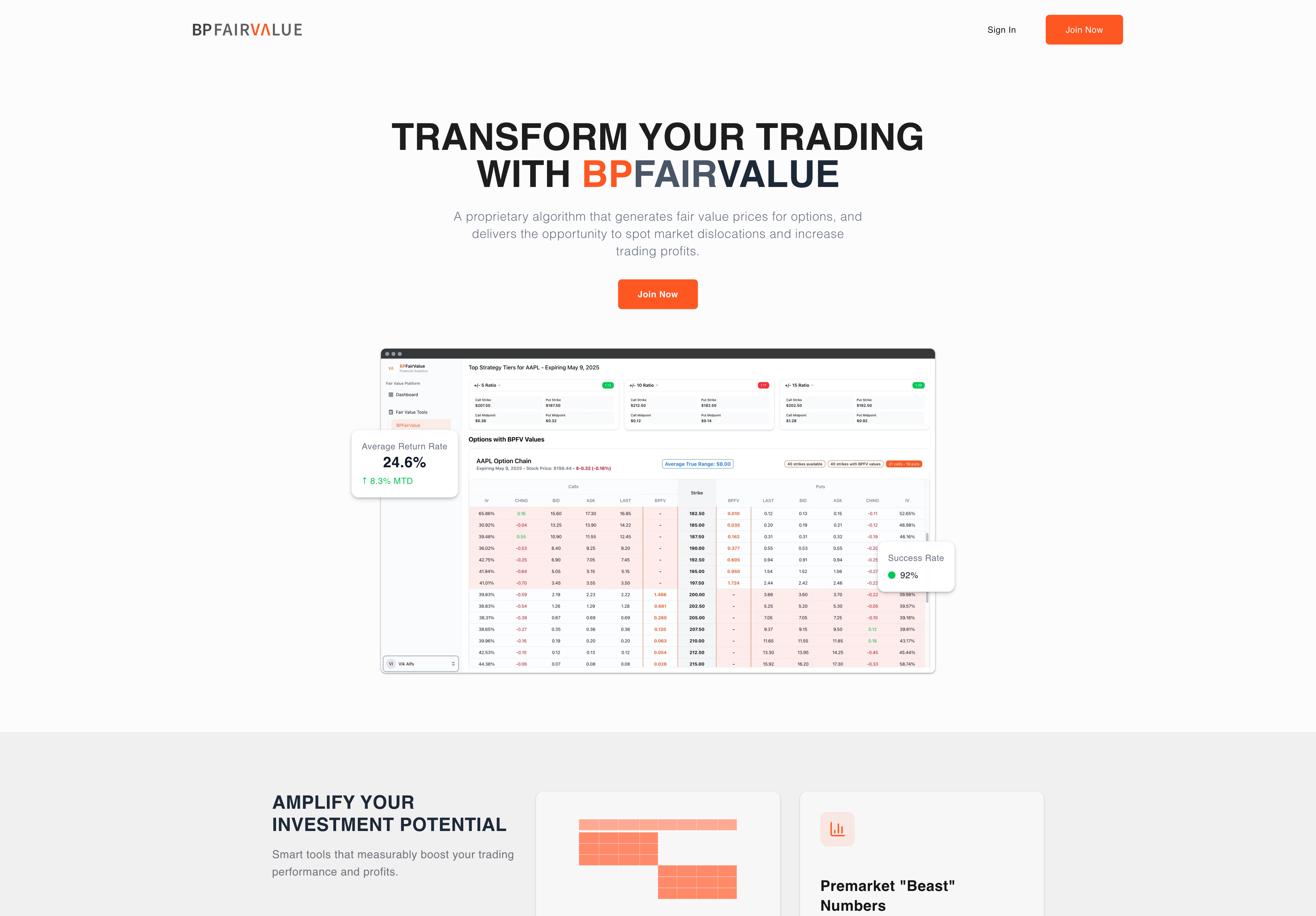
BPFairValue is a subscription platform for active options traders. It centers on a proprietary fair value model for options prices, plus premarket Levels of Interest (LOI) to highlight support and resistance context, a screener that highlights dislocations versus fair value, and market insights and blog content for ongoing education.
I focused on turning that methodology into a credible, fast web product: marketing narrative, tooling UI, and monetization paths that match how traders evaluate software.
Problem
Retail options traders are flooded with charts and opinions but short on repeatable frameworks for “what should this contract be worth?” and where liquidity and interest cluster before the open.
A product in this space has to:
- Explain fair value without hand-waving—institutional-grade language, accessible UX.
- Make premarket LOI and screeners feel actionable, not like a spreadsheet dump.
- Earn trust quickly: performance claims, demo content, and a professional visual system.
- Support subscriptions (e.g. beta pricing and tiered access) without friction.
Goals
- Communicate the value loop: fair value → dislocation → trade idea → risk-aware execution mindset.
- Ship dedicated surfaces for Fair Value, premarket LOI, Screener, and insights, consistent with the public positioning on bpfairvalue.com.
- Present metrics and social proof (e.g. highlighted performance stats) in a layout that feels data-forward but still marketing-safe.
- Provide demo and educational content so prospects understand the workflow before subscribing.
Solution
Product narrative
The site leads with a clear promise: fair value prices for options and the chance to spot dislocations. Supporting sections spell out why each module exists—Fair Value Tool, Premarket “Beast” numbers / LOI, Screener, Market Insights, and Blog—so visitors map features to their own process.
Tooling UX
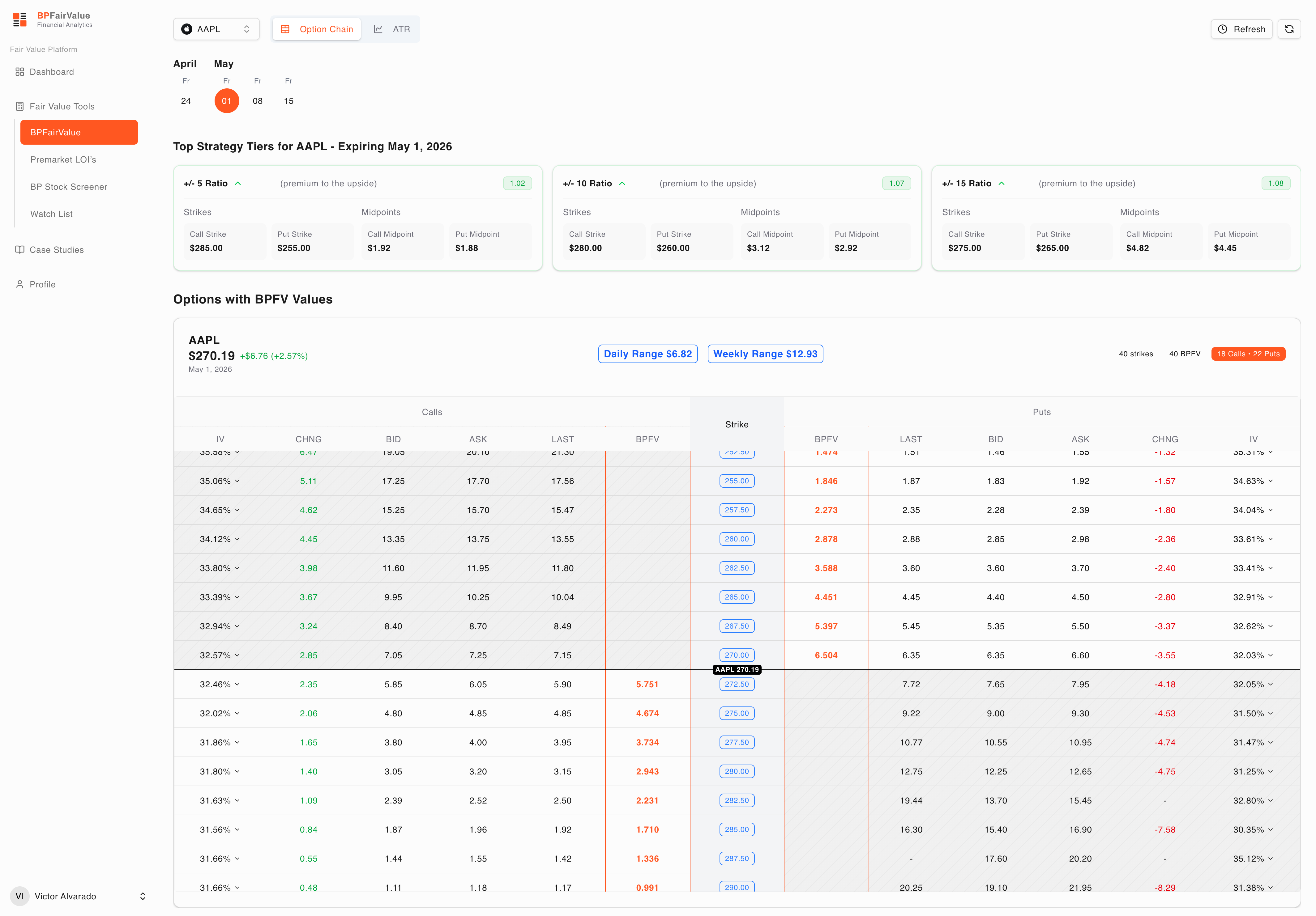
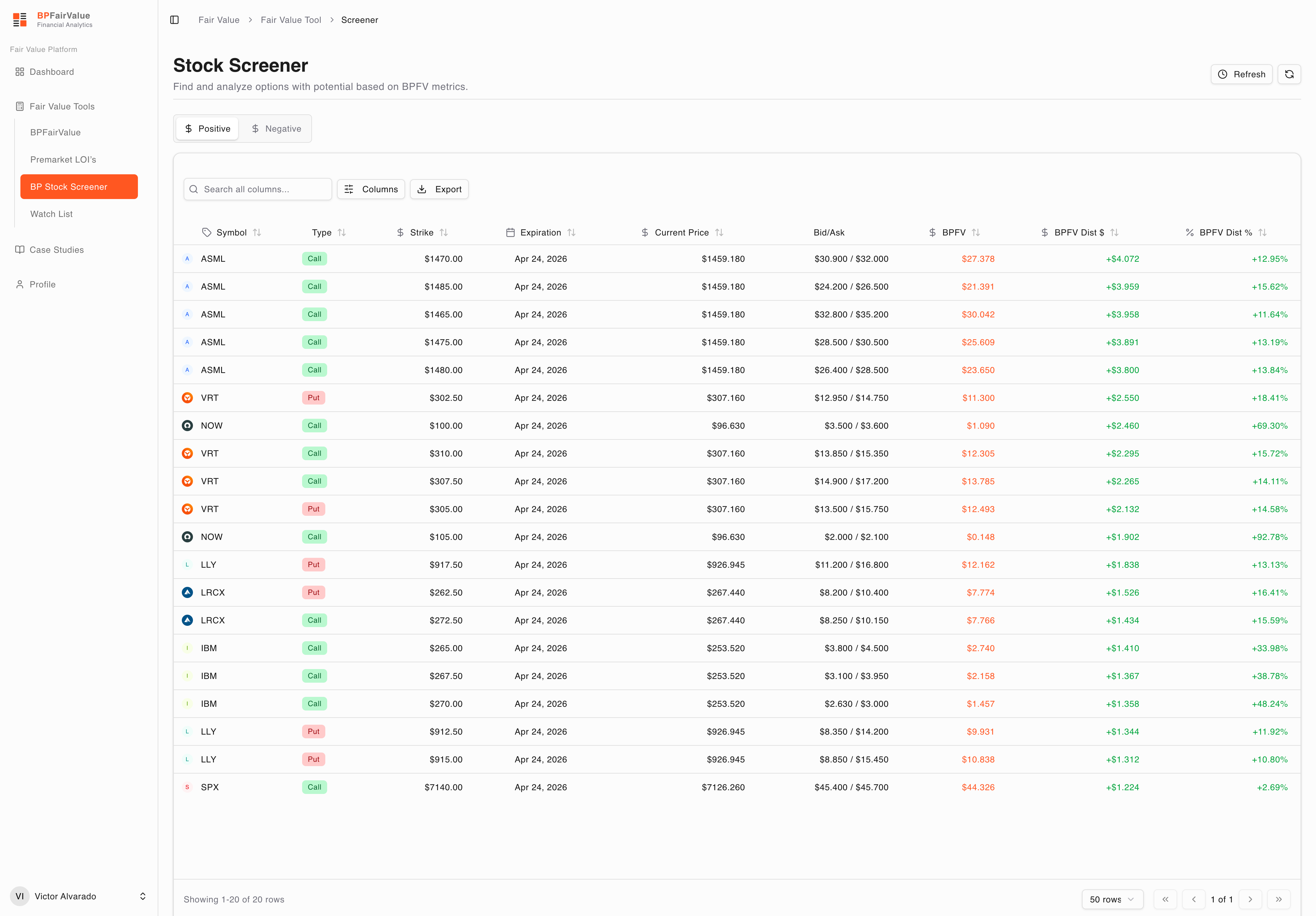
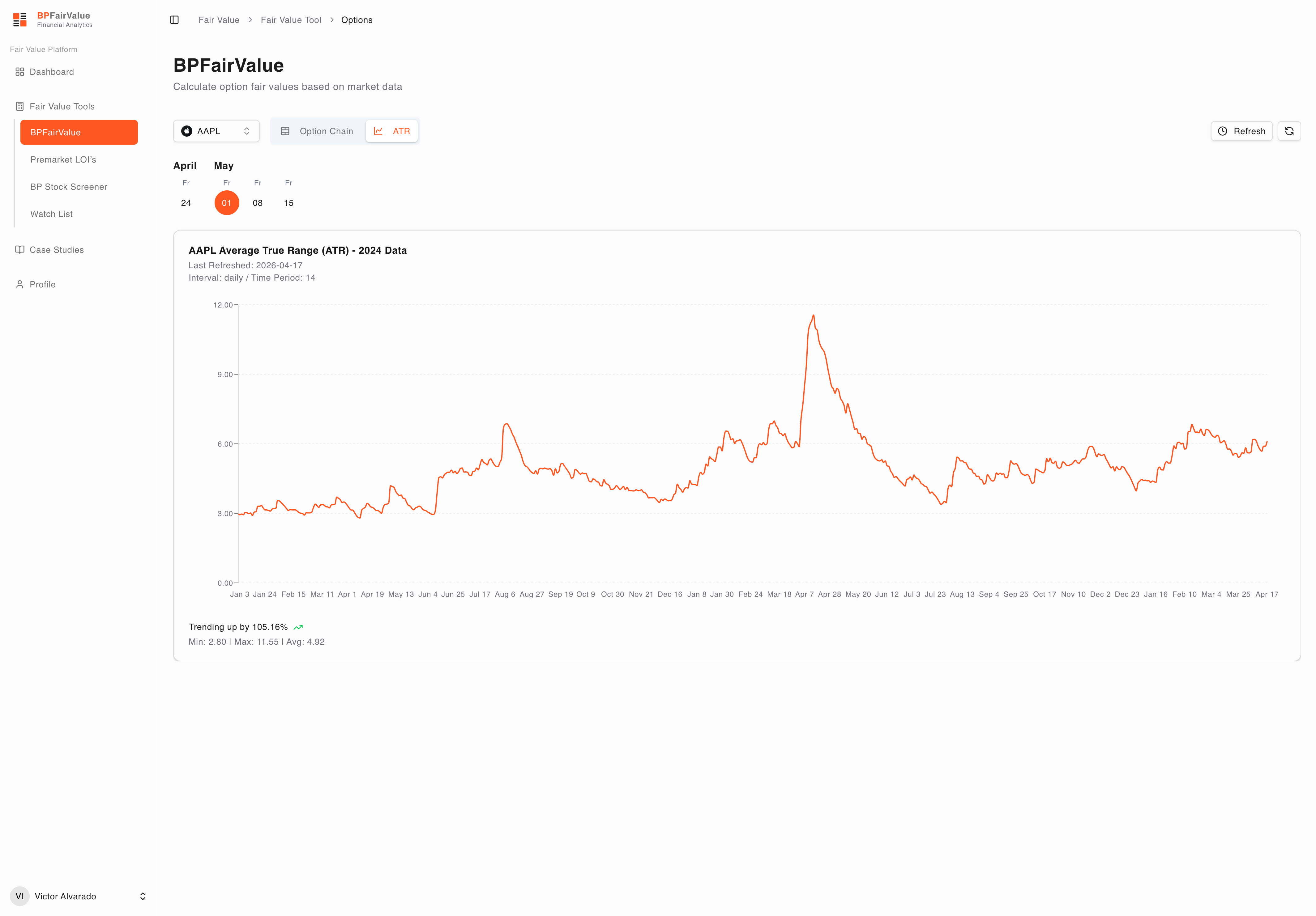
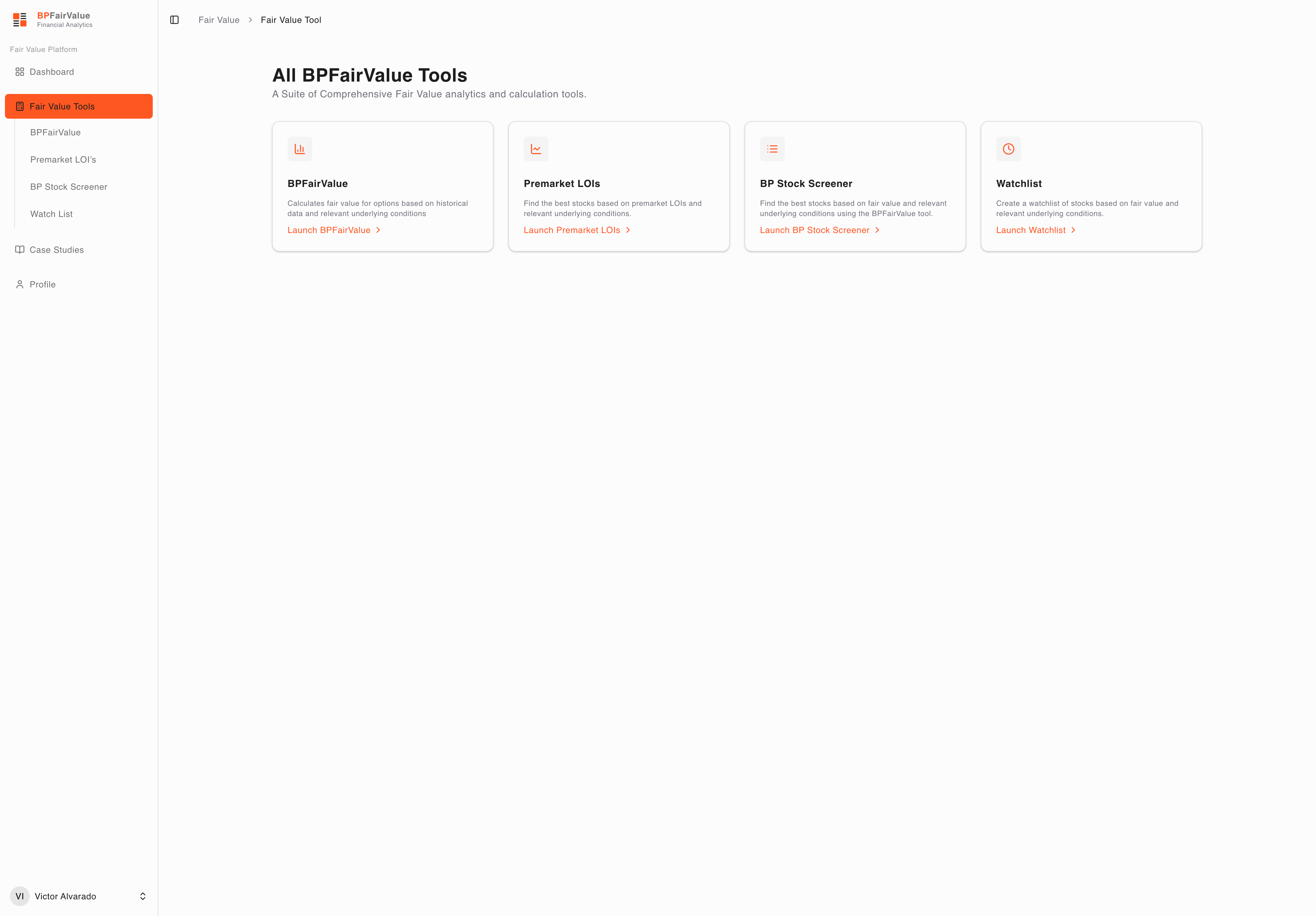
The in-app experience prioritizes scanning and comparison: traders need to move from symbol → fair value context → list of candidates without losing orientation. Screenshots below show representative dashboard and tool layouts shipped for the product.
Go-to-market
Public pricing reflects a beta-style offer (promotional monthly rate with a path back to standard pricing), aligning acquisition with early-adopter expectations. Sign in / Join flows connect interest on the marketing layer to ongoing access in the product.
Tech highlights
- Next.js and React for a fast, SEO-aware marketing and application shell.
- TypeScript end-to-end for safer iteration on financial UI and data shapes.
- Tailwind CSS for a consistent design system across landing and dashboard surfaces.
- Stripe for subscription billing and plan changes.
- Vercel (or equivalent) for deployment and edge-friendly delivery of static and dynamic routes.
Exact service boundaries (auth provider, data APIs, market data vendors) are intentionally summarized.
Challenges
1. Real-time options data pipeline
The core engineering challenge was sustaining a real-time fair value pipeline across three pressure points at once:
- Market-data latency and freshness. Fair value is only useful if it reflects the current book. The pipeline had to refresh prices every second during market hours without hammering upstream providers or blowing past rate limits — solved with a server-side polling and caching layer that fans out a single upstream update to all connected clients, plus a user-selectable refresh interval (1s / 10s / 20s / 30s) so traders can trade freshness for bandwidth on slower connections.
- Scaling the fair value compute. The proprietary model has to run across thousands of contracts fast enough to feel live. Work went into shaping the compute path so the screener, fair value tool, and LOI surface share the same hot dataset instead of each re-deriving values — cutting redundant work and keeping the UI responsive.
- Premarket LOI timing window. Levels of Interest are most valuable in the narrow window before the open. Missing that window makes the feature useless for the day, so the LOI job had to be scheduled, monitored, and fail-loud — with fallback handling if upstream data was late or incomplete.
2. Density vs. clarity
Options analytics UIs can overwhelm. The work balanced tables, highlights, and hierarchy so a trader can answer “so what?” in seconds — consistent row density, prominent dislocation cues, and tool-to-tool navigation that never loses the active symbol.
3. Claims and compliance tone
Performance callouts and methodology copy need to stay clear without over-promising. Engineering supported repeatable content patterns (structured components for stat blocks, disclaimers, and methodology copy) that make legal review fast and consistent.
4. Beta to steady-state pricing
The product had to support promotional beta messaging and a clean upgrade path as tiers mature, without rebuilding the pricing page or disrupting existing subscribers in Stripe.
Outcomes
- 2,000+ active subscribers on the platform.
- ~60% visitor-to-signup conversion on the marketing site — roughly 6 in 10 visitors enter the signup flow.
- Lighthouse: 100 / 100 / 100 on Performance, Best Practices, and SEO, and 93 on Accessibility for the landing experience.
- Sub-second fair value refresh by default, with user-selectable 10s / 20s / 30s intervals for lighter loads.
- A unified brand and product presentation from hero through dashboard and pricing, with modular tool positioning (Fair Value, LOI, Screener, Insights) that scales as new datasets ship.
Final takeaway
BPFairValue is a strong example of quant ideas made usable: the differentiator is the model, but the delivery is product craft—landing story, disciplined dashboard UX, and commercial structure that meets traders where they already work.