Commerce UX that respects inventory reality.
A modular product story—core strap, interchangeable patches, and bundles—needed a storefront that could market patches heavily while keeping stock and checkout honest.
Overview
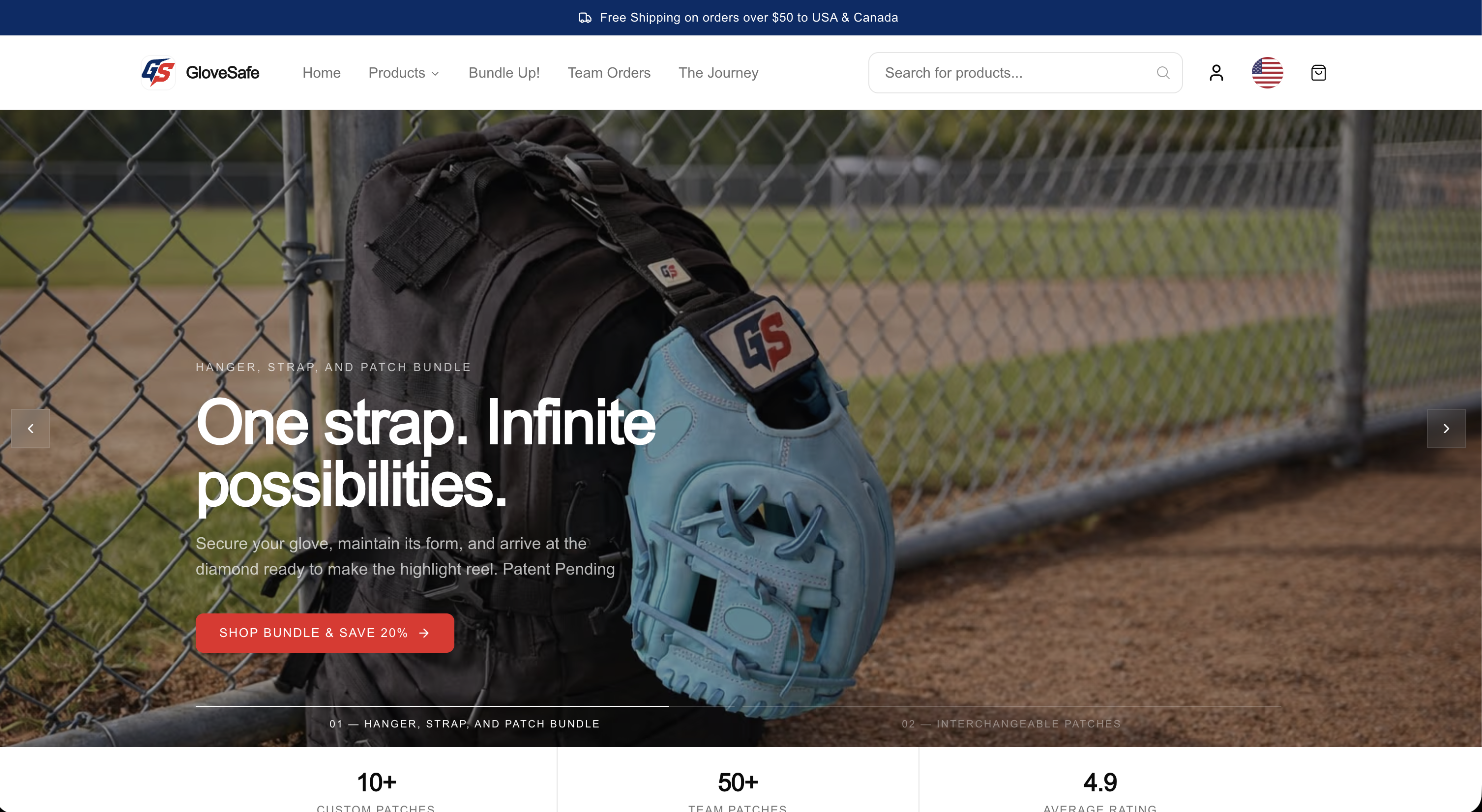
GloveSafe sells a wrist strap and lanyard system for baseball and softball gloves, plus a growing catalog of hook-and-loop patches. The business model combines a core SKU with high-rotation patch SKUs and bundle offers where customers buy the core and select a fixed number of patches at a discount.
I planned and built the experience around Shopify (backend) and a Next.js storefront, using patterns from the Vercel nextjs-commerce template as a foundation—then layering custom flows for bundles, upsells, and team orders.
Problem
Selling “bundles” in a headless stack is easy to get wrong:
- Fake bundle SKUs hide real inventory and create fulfillment surprises.
- Patch-first merchandising needs strong collection and PDP UX—patches drive revenue and repeat purchases.
- Discount rules must apply reliably when the cart contains multiple line items, not a single composite SKU.
- B2B team orders need a lightweight lead path without rebuilding checkout.
The product also needed room to scale from thousands toward 8,000+ patch SKUs without the storefront falling over on navigation or SEO.
Goals
- Launch a fast, reliable storefront with patches at the center of navigation and merchandising.
- Implement a bundle builder: core product + exactly N patches (configurable), with validation, live totals, and clear add-to-cart behavior.
- Keep checkout on Shopify to minimize compliance and payment risk while still feeling seamless.
- Support Canada and US shipping rules (e.g. free shipping above a threshold) and operational clarity for the client team.
- Provide Team Orders as a structured lead form (not automated B2B checkout in phase one).
Solution
Architecture
- Shopify remains the source of truth for products, variants, inventory, prices, discounts, and checkout.
- Next.js owns the customer experience: IA, performance, SEO, and the bundle UX.
- Storefront API (GraphQL) powers catalog reads; cart flows create the right line items and hand off to Shopify checkout.
Bundles are not implemented as synthetic SKUs. The customer sees one cohesive offer, but the cart contains separate line items for the core and each selected patch so inventory decrements per real SKU—matching the blueprint’s “multiple line items + automatic discount” approach.
Bundle builder UX
The “Build your setup” style flow makes four ideas obvious:
- What the core includes.
- That the user must pick exactly N patches (with clear validation if the count is wrong).
- Price and discount update as selections change.
- Add to cart adds core + patches together in a predictable way.
Edge cases—out of stock, low stock messaging, blocking checkout until the selection is valid—are handled in the UI so support load stays low.
Beyond the bundle
- Collections and PDPs for core, patches, and deals.
- Cart upsells suggesting additional patches.
- Team Orders page for bulk and custom inquiries—capture and route leads without forcing a bespoke B2B checkout in v1.
SEO, analytics, and performance
Metadata, clean URLs, and indexable collection pages support organic discovery for patch-heavy searches. Analytics hooks target standard commerce events (view item, add to cart, begin checkout). Images and caching strategies align with Core Web Vitals goals for a large catalog.
Tech highlights
| Area | Approach |
|---|---|
| Storefront | Next.js (App Router–style stack), React, TypeScript |
| Commerce API | Shopify Storefront GraphQL API |
| Checkout | Native Shopify checkout (redirect / cart URL patterns) |
| Hosting | Vercel-aligned deployment model |
| Operations | Client manages catalog and fulfillment in Shopify Admin—no custom admin panel required for phase one |
Delivery phases (from blueprint to launch)
Work was sequenced to reduce risk: Shopify operational setup (taxes, shipping zones, products, collections) → connected storefront → bundle builder → upsell funnel → team orders → SEO/analytics hardening → UAT and go-live (DNS, payment verification, test orders, inventory checks).
Outcomes
- 500+ orders shipped since launch on 4 Mar 2026, with inventory staying accurate across bundles and single-SKU purchases.
- 25 B2B team-order leads captured through a lightweight inquiry form — no custom B2B checkout needed in v1.
- 3,000 live SKUs at launch, on an architecture sized to scale to 8,000+ without re-platforming.
- Operational simplicity for the business: day-to-day changes (products, prices, inventory, discounts) happen in Shopify Admin, not in code.
- Foundation for growth in catalog size and future enhancements (search, affiliates, deeper B2B) — without rewriting the commerce core.
Challenges
1. Keeping Shopify and Next.js in sync
The hardest problem was running a fast, cache-heavy Next.js storefront without ever drifting from Shopify’s inventory truth. A few concrete decisions shaped the solution:
- Single source of truth. Products, variants, prices, inventory, and discounts live in Shopify — full stop. Next.js never owns commerce state; it reads via the Storefront GraphQL API and composes the experience on top.
- Cache with invalidation, not TTL guessing. Collection and PDP pages are aggressively cached for speed, but Shopify webhooks trigger on-demand revalidation whenever products, inventory, or collections change. That keeps pages fast without serving stale “in stock” lies.
- Cart lives server-side on Shopify. The bundle builder composes line items in the UI, but the cart itself is a Shopify Cart object — so discount rules, taxes, and checkout hand-off all Just Work, and multiple tabs stay consistent.
- Graceful reads during outages. The storefront tolerates transient Storefront API slowness with sensible request timeouts and cached fallbacks, so a blip upstream doesn’t blank the shelf.
2. Bundle discounts vs. real line items
The bundle is presented as one offer, but the cart must carry separate line items so inventory decrements per real SKU. Choosing between automatic discount rules and controlled discount codes had to happen early — both were tested against edge cases (partial inventory, mixed-bundle carts, abandoned-cart recovery) before committing.
3. Catalog scale
Thousands of patch SKUs demand disciplined pagination, filtering, and image strategy so collection pages stay fast as the catalog grows from 3,000 toward 8,000+ — and so Google can actually crawl and index the long tail.
4. UX vs. implementation honesty
The storefront must present a single cohesive bundle while the implementation stays honest per SKU. Alignment between the bundle UI (count validation, live pricing, stock messaging) and the cart’s underlying line-item structure was essential to avoid “it added what?” support tickets.
Final takeaway
GloveSafe is a practical Shopify + Next.js engagement: headless where it improves experience, hosted checkout where it reduces risk, and a bundle story that matches how the business actually stocks and ships product—one strap, many patches, infinite shelf combinations.