Marketing that speaks to homeowners, managers, and businesses.
HVAC companies compete on trust, speed, and clarity. Speed AC needed a modern site that could speak to residential customers, property managers, and commercial clients—without three separate brands—while keeping leads flowing through forms and future-proofing content in a CMS.
Overview
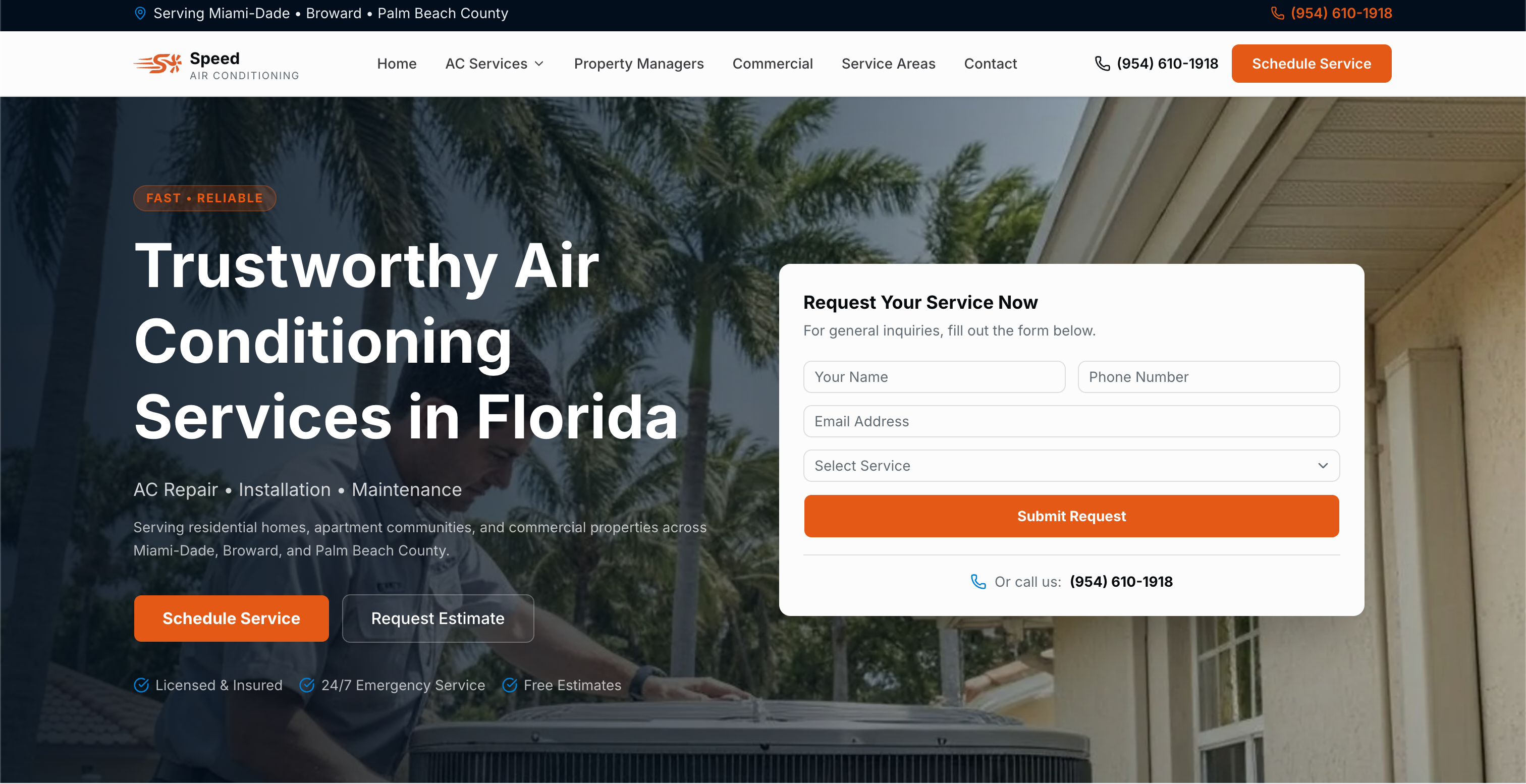
speed-ac is a Next.js marketing website for a South Florida HVAC contractor. The experience is built around clear service messaging, service-area coverage, and lead capture (quote and contact). Content is backed by Sanity: global settings, navigation, pages, services, service areas, testimonials, blog material, and SEO fields—editable through Sanity Studio mounted at /studio inside the same app.
What shipped
Homepage and marketing surface
The home page brings together the story end-to-end: hero, services, process, about, stats, testimonials, an emergency CTA, a blog teaser, and service-area sections—so visitors can self-select and convert without hunting.
Audience-specific journeys
Dedicated routes support distinct intents:
- AC Services — residential-focused service detail and trust building.
- Property Managers — messaging tuned for multi-unit and ongoing relationships.
- Commercial — B2B-oriented positioning.
- Service Areas — geography and coverage made explicit for local SEO and user confidence.
- Contact — a clear path to reach the business.
Responsive header and footer navigation ties the IA together with consistent branding.
Leads and communication
- Quote and contact forms run on the client with React Hook Form, keeping validation and UX snappy.
- React Email supports template development (
pnpm email:devfor a local preview server), so transactional and lead-related emails stay maintainable alongside the app.
Content management
Sanity Studio is embedded at /studio (not a separate deploy), which lowers friction for editors and keeps CMS configuration versioned with the site.
Schemas cover:
- Global site settings and navigation
- Homepage and other marketing pages
- Services and service areas
- Blog posts and categories
- Testimonials
- Reusable SEO and rich text building blocks
The model is designed so hardcoded marketing strings can migrate into Sanity incrementally—practical for a live project that must ship before every paragraph lives in the CMS.
Tech stack
| Layer | Choices |
|---|---|
| Framework | Next.js 16 (App Router), React 19, TypeScript |
| UI | Tailwind CSS 4, shadcn/ui, Radix primitives |
| Motion | Motion for animation |
| Forms | React Hook Form |
| CMS | Sanity + next-sanity |
| React Email | |
| Tooling | pnpm for installs and scripts |
Challenges
- One brand, multiple buyers — Copy and IA had to signal residential, PM, and commercial value without cluttering the nav or duplicating everything three times. Separate landing-style pages plus a shared home story balanced that.
- CMS without a big-bang migration — Shipping with a full Sanity model while some content remains static requires discipline: schemas first, then gradual content moves so launches are not blocked.
- Local services + SEO — Service-area and service pages need consistent metadata and structure; Sanity SEO fields and reusable objects support that as content grows.
Outcomes
- Lighthouse 100 / 100 / 100 / 90 on Performance, Best Practices, SEO, and Accessibility for a multi-section marketing site.
- One brand, three audiences — residential, property managers, and commercial — with cohesive IA and no duplicated navigation.
- Editors get a real CMS path via embedded Studio at
/studioand structured content — not one-off code changes for every tweak. - Modern Next.js stack (App Router, React 19, Tailwind 4, shadcn/ui, React Hook Form, React Email) delivered as a maintainable long-term asset for the client.
Final takeaway
Speed AC shows how I approach local-service marketing sites: strong IA and conversion paths, headless content where the business will keep iterating, and embedded Studio so stakeholders stay close to the product—not a separate “CMS server” mental model.